Nanobubbles: Re-Engineering Water Treatment – And Beyond
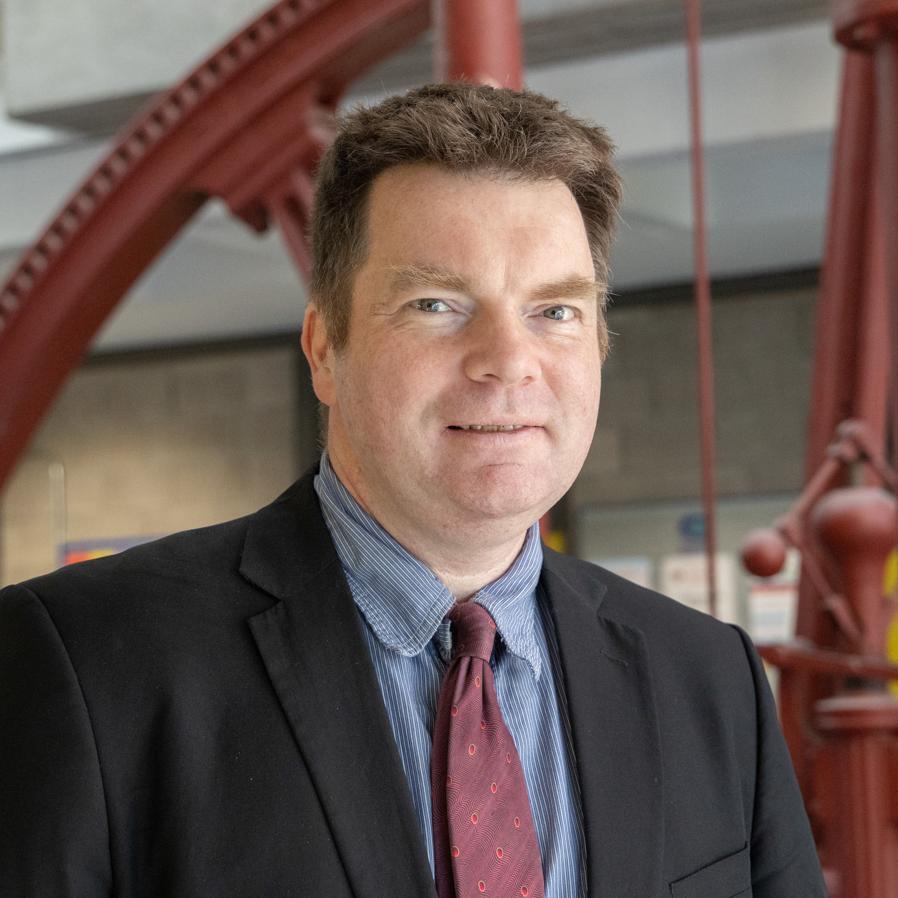
by Niall English
CTO, Director
A major and fundamental challenge is limited solubility in many liquids, e.g., gases, such as oxygen, and especially hydrogen, in water.
In ecosystems and the environment, lack of dissolved oxygen (DO) is a significant reason for fish kills and water bodies being blighted by algal blooms, in addition to sometimes lack of effectiveness concerning activated-sludge processes in water treatment or poorer-than-hoped results in irrigation.
At AquaB, we are commercialising novel water-gasification technologies based upon our breakthrough low-energy nanobubble (NB)-generation approaches. The company was set up in 2020 as a spin-out from Chemical Engineering at University College Dublin (UCD), to commercialise the patented platform NB-generation technology lead-invented by Company Director, inventor, chartered chemical engineer and industrialist Professor Niall English – who is also based at UCD Chemical Engineering, and holds an ERC Advanced grant on NBs with very broad applicability across several application areas. Since 2020-21, AquaB has been developing NB generators at TRL 4-8, aided by its European Innovation Council Accelerator Grant.
With record levels of fish-kills and blue-green algae infestations in water bodies, such as lakes, reservoirs, canals, rivers and estuaries in the past year or so (owing largely to excessive fertiliser usage in groundwater run-off from agriculture), and as global warming continues apace, we have seen the dramatic fall-out from low levels of DO: the fish die and cyanobacteria “take over”, meaning that the water is almost de-oxygenated and effectively “dead”. The resultant methane-rich stench emanating from the depths arises from a lack of oxygen – anaerobic conditions – deeper in the water.
Fully one-third of methane emissions to the atmosphere – perhaps 15-20 times worse for global-warming potential per tonne than CO2 – arise from under-aerated waterways. The levels of DO fall as the temperature rises – meaning that fish-kills are becoming all the more common now outside of high-summer with greater levels of warming.
This gas-solubility limit – in other words, the amount of gas (like oxygen) that can be accommodated naturally in water (or other liquids) – is known as “Henry’s Law”. For centuries, it has been taken for granted that there was no way to accommodate additional levels of gas in liquids beyond this “thermodynamic limit”, other than for very short times – at great energy and operational expense.
However, my lead-invention and development of energy efficient, membrane-free and additive-free methods to generate vast quantities of NBs in liquids, such as water, with long-lived nature to allow for the level of gas solubility to be increased meaningfully beyond the Henry’s-Law limit – could banish fish-kills to the past – and “breathe life back to water” – literally.
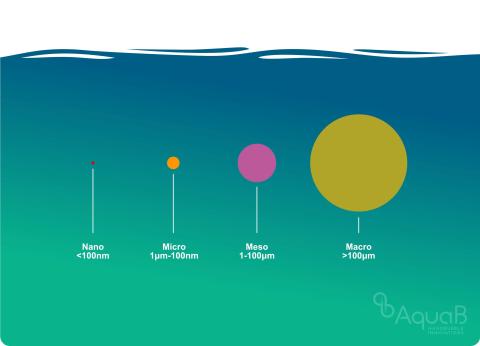
The Scale of Nanobubbles
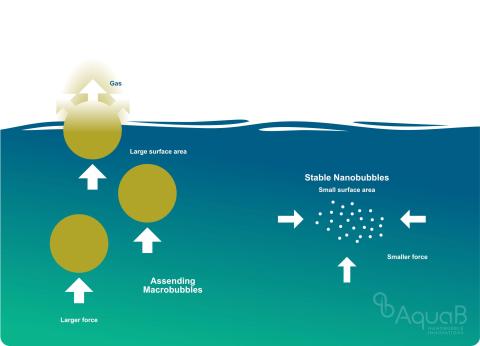
NBs are tiny gas bubbles on the nanometre (nm) scale. They may be thermodynamically metastable for up to many months, or sometimes even longer, and have enhanced gas-transfer properties and substantial industrial potential. These NBs, shorter than the wavelength of light, are not visible to the naked eye, and are orders of magnitude smaller in dimension than the width of a human hair.
Electric Field Nanobubble Generation
AquaB’s method of generating NBs is based on static electric fields and electrostriction-based “sucking in” phenomena of gases into liquids – making “thick-skinned”, or ultra-dense, NBs with great mechanical strength and enhanced lifetime. After many industrial field trials in 2021-23, with further ongoing in 2024, it has been shown that these can deliver a step-change in the operational efficiencies of many industrial sectors.
When dissolved-gas levels are reduced, surface NBs tend to become smaller, albeit retaining their metastability, in stark contrast to thermodynamic predictions. In contrast, bulk NBs typically have 50–200 nm diameters, and their size can respond to ions and additives.
There is much industrial and ecological interest in the presence of bulk NBs, in that their occasional long life and stability, depending on their method of generation and bulk-liquid conditions, often exceed the residence time of many processes such as aeration cycles in activated-sludge tanks for wastewater treatment and recirculation-aeration systems or more broadly, for water-body aeration. This long life is particularly true for NBs generated via electrostriction.
Accelerating Environmental Sustainability
AquaB believes firmly that its commercially proven NB-generation technology will accelerate the company’s positioning in the marketplace for water management and treatment, with multiple customers and addressing UN Sustainable Development Goals (water, atmosphere) for the greater good of Man and the Earth’s environment.
With the current focus of governments, industry and research organisations around the world in a ‘race against time’ to implement the Paris Accord and tackle the degradation of the Earth’s environment and climate, a disruptive new technology with excellent energy, environmental and economic sustainability is needed for both water and the atmosphere.
Europe’s recent and well-placed leadership in the world-leading ‘Green Deal’ initiative shows how there can be – and should be – no conflict between economic growth and environmental/ climate progress. This calls for disruptive new green technologies as the world faces unprecedented turbulence and economic crisis in the 2020s, with population growth putting massive pressure on freshwater resources. Never has the need for environmental sustainability and water treatment been so critical – never has there been such a need for NBs.
AquaB Selected for BREW 2.0 Accelerator Program by The Water Council
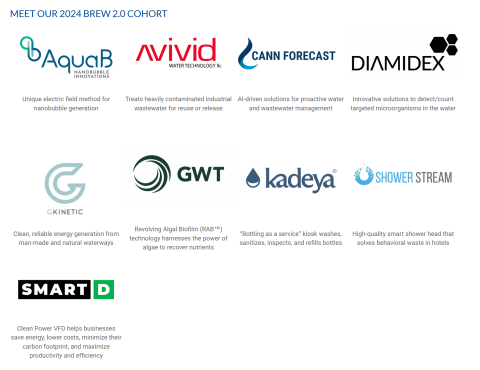
AquaB Nanobubble Innovations Ltd has been selected as one of ten participants in BREW 2.0, a water technology accelerator run by The Water Council, a global hub dedicated to solving critical water challenges by driving innovation in water technology and advancing water stewardship.
The Business, Research and Entrepreneurship in Water (BREW) Accelerator 2.0 is an international programme designed to help young companies who are market-ready build connections and grow their company’s capacity.
It focuses on businesses with products and components related to water quality and quantity, including wastewater treatment. This virtual and in-person hybrid program focuses on expert-led sales and growth training tailored for water tech businesses.
AquaB’s nanobubble generator products - which utilise a unique electric-field based method to generate bulk nanobubbles - have applications in waste water treatment, algae regulation and in the energy sector.
The company’s participation in the 2024 cohort will be led by AquaB’s CEO Paul Kilroy Glynn
AquaB Nanobubble Innovations Ltd announces key appointments
Kildare-based technology start-up AquaB Nanobubble Innovations Ltd has announced key appointments to its leadership team ahead of the company’s participation in World Water-Tech North America, which takes place in Los Angeles this week.
AquaB, a University College Dublin (UCD) spin-out company, was incorporated in 2020 to commercialise the electrostriction nanobubble generation technology lead-invented by Professor Niall English. The technology is widely considered to be a globally significant breakthrough in the management of liquid and gases in industry.
Professor English, initially CEO, becomes Chief Technology Officer, as Paul Kilroy Glynn is appointed CEO of AquaB.
Specialising in business development in the start-up tech space, Paul was previously Head of Business Development at BioSimulytics, a Dublin-based pharmatech UCD spin-out. Paul’s leadership of AquaB benefits from his academic background in life sciences and previous business development leadership with Prof. English at BioSimulytics.
Alan Kennedy joins AquaB as Chief Operating Officer. Most recently Research Fellow at the University of Galway, Alan’s background combines research and development in the wastewater treatment industry with industrial applications.
Elaine Shaw, former CEO of Northway Mushrooms Ltd, has taken up the role of Head of Operations and Finance, supported by Sorcha Mallon as Financial Controller, while post-doctoral engineer Donagh Tuite joins as Head of Production.
The Ireland-based company is supported by Hanan Itzkovitch based in Israel, who brings international business development experience in the water and environmental sectors.
Announcing the appointments, CEO Paul Kilroy Glynn said:
“Nanobubbles are set to accelerate the sustainability of environmental and industrial processes at a global level, and AquaB has an important role in making nanobubble generation accessible, affordable and scalable. I’m delighted to be leading the company and look forward to fully unlocking the commercial potential of electric-field nanobubble technology.
“It’s a privilege to be working with Prof. English again, and to be joined by such a talented and experienced team. We are all excited about the potential this technology has to radically improve energy efficiency and productivity in key sectors that are at the forefront of the climate challenge.”
As the smallest, ultrafine bubble - 50 to 100 nm in size - nanobubbles are invisible to the eye but have distinct properties that make them transformative for a wide range of processes and applications. The potential of nanobubbles has been known for years, but the barrier to widespread adoption has been the challenge of developing energy efficient, controllable, reliable generation.
AquaB’s nanobubble generators utilise a novel method to generate nanobubbles using static electric fields. The method, lead-invented by Professor Niall English, produces high concentrations of bulk nanobubbles at scale with minimal energy needs.
The company is prioritising commercialisation in the oil and gas and water treatment industries. An early focus is the regulation of algae - an increasingly important intervention as algal blooms are impacted by climate change and the ensuing damage caused.
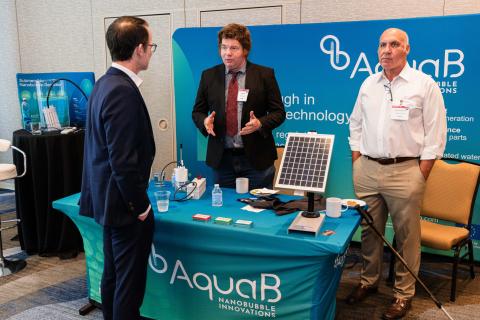
AquaB is showcasing its submersible nanobubble generator units at World Water-Tech North America, which takes place in Los Angeles from today. The event will see more than 200 water industry leaders gather to address the most challenging issues facing water and wastewater in North America.
Mr Kilroy Glynn added:
“The potential for AquaB is truly global, and there is strong interest in this technology from companies and organisations operating in arid climates where water is an increasingly scarce resource.
“Ireland’s leadership in this sector is notable and important. I’m honoured to be working alongside Prof. English and such an experienced team as the commercial application of nanobubble generation becomes ever more urgent in the race to mitigate the impacts of climate change.”
Niall English
CTO, Director
Professor Niall English is the lead-inventor of the electrostriction nanobubble generation technology that AquaB systems utilise. Niall is recognised globally as an expert in how external fields affect the ordering and behaviour of systems at the nanoscale and his research interests encompass nanoscience, electric-field effects, nanobubbles, carbon capture and gas hydrates. In addition to commercialising his nanobubble generation breakthrough at AquaB, Niall is a professor in Chemical Engineering at University College Dublin where he is investigating how electric-field-generated nanobubbles and nanodroplets can be optimised in their characteristics for use in water treatment, agriculture, aquaculture and carbon capture.
AquaB reveals new brand identity at World Agri-Tech Innovation Summit
Technology start-up AquaB Nanobubble Innovations Ltd launched a new corporate identity at the World Agri-Tech Innovation Summit in London earlier this week.
Agri-Tech, which took place from 26-27 September, saw more than 1,000 international agri-food professionals participate in two days of discussions and networking to accelerate the transition to sustainable and resilient agri-food systems.
AquaB’s attendance focused on the application of the company’s groundbreaking electric field nanobubble generator units for the regulation of algae - an increasingly important intervention as algal blooms are impacted by climate change and the ensuing damage caused. The company also unveiled a refreshed brand identity with the aim of solidifying its position as a global pioneer in the field of water treatment technology.
As the smallest, ultrafine bubble - 50 to 100 nm in size - nanobubbles are invisible to the eye but have distinct properties that make them transformative for a wide range of processes and applications. The potential of nanobubbles has been known for years, but the barrier to widespread adoption has been the challenge of developing energy efficient, controllable, reliable generation.
AquaB nanobubble generators utilise a novel method to generate nanobubbles using static electric fields. The method, lead-invented by Professor Niall English of AquaB, produce high concentrations of bulk nanobubbles at scale with minimal energy needs, precision control, solid state reliability and deployment flexibility.
Speaking after the Agri-Tech Innovation Summit, Professor English said:
“As the potential commercial application of ultra-low energy nanobubble generation becomes ever more apparent, we were pleased to demonstrate the benefits of our technology to a wide range of businesses, organisations and researchers.
“In the race to mitigate and adapt to the impacts of climate change, nanobubbles have the potential to transform the management of ecosystems for the benefit of the global food system, and the benefit of our planet. I’m hugely excited about the platform-wide possibilities this technology has, and it was encouraging to see so much interest in it at this event.”
Prof Niall English receives ERC Advanced Grant to optimise nanobubble technology for diverse end applications
The European Research Council (ERC) has selected internationally renowned research leader, Professor Niall English, as a recipient of its highly prestigious 2023 Advanced Grant.
At a value of upwards of €2.5 million, these grants allow established research leaders to perform world-leading investigation of cutting-edge and high-risk / high-gain phenomena. Past recipients have included Nobel laureates and leading scientists who have gone on to make major contributions to their respective fields.
Through the NIMBLE project, Professor English, UCD School of Chemical and Bioprocess Engineering, will investigate how electric-field-generated nanobubbles and nanodroplets can be optimised in their characteristics for use in water treatment, agriculture, aquaculture and carbon capture.
Nanobubbles are tiny gas bubbles on the nanometre (nm) scale. ‘Nanobubble technology’ can remove impurities and pathogens from wet environments, improving production and processes across many applications in a broad range of sectors. The NIMBLE project will build on the low-energy, highly-efficient platform technology of nanobubble generation developed by Professor English’s research group in UCD.
Commenting on NIMBLE, Professor English said, “This ERC project will enhance our understanding of how electric-field engineering can predict the effectiveness of molecular engineering of nanobubbles, through optimal deployments in a range of settings. The use of nanobubbles as delivery agents for smart aquaculture and agriculture is a seminal development, and more efficient carbonation strategies by way of low-energy gasification, reactive species and flotation characteristics, could revolutionise water treatment and carbon capture.”
“The development of NIMBLE owes a deal to the persistent work of our group’s young and ambitious researchers, as well as international collaborators in academia and industry – whom I now salute today. I must also thank the European Commission, Bord Gáis, Enterprise Ireland, and Science Foundation Ireland (e.g. I-Form and iCRAG) for supporting the nano-phase R&D journey.”
UCD Vice-President for Research, Impact and Innovation, Professor Helen Roche said: “Congratulations to Professor Niall English on this great achievement. The highly competitive ERC Advanced grants recognise research leaders who are contributing valuable new knowledge within their fields, and whose work has real benefits for the global community. We look forward to seeing the far-reaching impact of the NIMBLE project.”
The ERC Advanced grants – totalling €544m for 2023 – provide researchers with the opportunity to pursue ambitious, curiosity-driven projects that could lead to major scientific breakthroughs. In addition to strengthening Europe’s knowledge base, the grants are expected to create more than 2,000 jobs for postdoctoral fellows, PhD students, and other staff at host institutions in 20 countries.
EU Commissioner for Innovation, Research, Culture, Education and Youth, Mariya Gabriel said: “ERC grants are a top recognition and a significant commitment from our best researchers. The €544 million funding puts our 218 research leaders, together with their teams of postdoctoral fellows, PhD students and research staff, in pole position to push back the boundaries of our knowledge, break new ground and build foundations for future growth and prosperity in Europe.”
An inventor, professor, chartered chemical engineer (FIChemE) and industrialist, Professor English is the co-founder of two prestigious European Innovation Council (EIC) Accelerator-backed spin-outs, AquaB and BioSimulytics. In 2020, AquaB won the IChemE Global Award in the Water Award category based on the breakthrough platform nanobubble technology. Biosimulytics was the overall winner of the 2019 UCD VentureLaunch Accelerator Programme and received the NovaUCD Spin-out of the Year Award in 2022 for its work to advance molecular simulation of crystal-structure prediction.
AquaB and Aramco at APSAC 2023 Conference
AquaB’s expertise in energy efficient nanobubble generation was highlighted at a special nanobubbles session at the APSAC 2023 applied-physics conference in Venice.
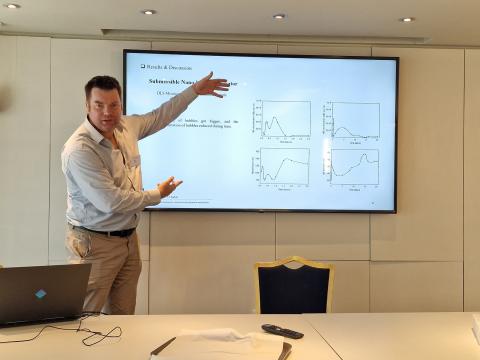
The workshop session titled Nanobubble Generation and Chemical Physics was jointly Chaired by Niall English of AquaB and Amr Abdel-Fattah of Aramco. The conference, the International Conference on Applied Physics, Simulation and Computing, brings together physicists, mathematicians, and engineers to share new analytical methods, simulation methods, and mathematical models, with a focus on diverse community participation.
The aim of the session was to consider the many mechanistic, physical, chemical and statistical aspects of various types of nanobubble generation and behaviour, as well as to explore engineering deployment, scale-up and performance case studies.
A key property of nanobubbles is their longevity and long-term stability. While larger bubbles rise to the atmosphere very quickly, nanobubbles have potential lifetimes of hours to months. This unique characteristic makes energy efficient nanobubble generation a potentially transformative innovation, capable of transforming a variety of environmental, medical, and industrial processes.
AquaB’s collaboration with oil and gas giant Aramco reflects the companies’ shared interest in the potential of nanobubbles to accelerate sustainability within the energy sector.
Professor Niall English, who lead-invented the electric field based nanobubble generation that AquaB is developing, said:
“The APSAC workshop considered new and innovative methods for generation of nanobubbles of different gasses, as well as rigorous exploration, elucidation and characterisation of their underlying microscopic fundamentals. We explored methods of exploiting and manipulating their formation with a view to end-goal engineering applications, as well as important industrial and environmental applications.”
R&D Nanobubbles Update
Nanobubbles
- Bubbles are gas-filled cavities within the liquid with variable properties depending on their size.
- Ordinary bubbles are not stable for long periods of time, rising and bursting on the surface, but bubbles in micron-size shrink and disappear in the solvent. However, Nanobubbles are stable for a significant amount of time.
- The total surface area of a certain volume of gas is in inverse proportion to the forming bubble diameter.
- The stability of nanobubbles, together with their high surface area per volume, endows them with important and useful applications.
Possible applications of nanobubbles: beverage and food
CARBONATION: C02 is an essential ingredient of carbonated beverages It enhances the flavour and body of the product and the effect of effervescence characterizes the refreshing taste of the beverage. The C02 content also influences beer foam structure and its stability. Therefore, consistent and accurate C02 is one of the main quality factors in the production of beer and soft drinks.
NITROGENATION: When added to beer, nitrogen creates a creamy and fine foam head with small bubble size; it improves the foam stability and softens the beer on the palate. While traditionally nitrogenation was applied in ales and stouts, the same process is nowadays successfully used for the classical lagers treating. Nitrogen increases beer foam stability of lagers up to 30 seconds. Due to its low solubility, nitrogen consumption is very low. Consistent and accurate nitrogenation will determine the appearance and quality of the final beverage.
AERATION/OXYCENATiON: Brewing yeast needs oxygen to multiply, While insufficient aeration results in reduced yeast reproduction, over-dosing may cause the formation of undesired substances and wort foaming. Therefore, controlled wort aeration is required for a consistent fermentation rate and constant product quality.
Possible applications of nanobubbles: sterilisation
Oxygen nanobubble contraction and collapse will generate reactive oxygen species (ROS) which with existing ozone can form a powerful sterilizer even more effective than chlorine. The short lifespan of the active oxygen makes it as a harmless by-product of nanobubble collapse; as the result sterilization with nanobubbles can be considered as a safe and effective technique.
Possible applications of nanobubbles: hydroponics
Oxygenating hydroponic waters with nanobubbles significantly improves the available oxygen to the plants and has been shown to improve nutrient uptake and promote growth by up to 30%. Nanobubbles can also prevent nitrates from accumulating within the tissues of the plant and helps maintain a healthy physiological balance boosting the plants’ natural resistance to disease. Adding ozone also proven to be highly effective at suppressing pathogenic bacteria and fungal infections in the plants.
Possible applications of nanobubbles: water treatment
Aeration is used in water- and wastewater treatment processes to deliver oxygen to microorganisms responsible for the biological oxidation of carbonaceous material and ammonia. Nanobubble aeration is a new technology designed to naturally control algae by exceeding the oxygenation capabilities of traditional aeration systems. With smaller, nanometer-size bubbles, the gas-liquid contact surface area is greatly increased per unit gas volume, increasing the contact time of oxygen with bacteria in a bioreactor, whilst also creating a healthier environment in the reactor. Aeration is used in water- and wastewater treatment processes to deliver oxygen to microorganisms responsible for the biological oxidation of carbonaceous material and ammonia. Nanobubble aeration is a new technology designed to naturally control algae by exceeding the oxygenation capabilities of traditional aeration systems. With smaller, nanometer-size bubbles, the gas-liquid contact surface area is greatly increased per unit gas volume, increasing the contact time of oxygen with bacteria in a bioreactor, whilst also creating a healthier environment in the reactor.
Possible applications of nanobubbles: cooling towers
Nanobubble empowered water used in cooling towers has an enhanced vaporization potential due to an increase in surface area of gas/water contact which will improve the efficiency of water-cooling towers. The presence of ozone nanobubble on the cooling system will add a significant anti-microbial action which reduces the formation of any biofilm inside cooling towers.
Possible applications of nanobubbles: aquaculture
Using nanobubbles in aquaculture farming will enhance the level of dissolved oxygen in the water which will cause an increase in the growth rate of fish and crustacean by about 30%. On the other hand, the sterilization potential of nanobubbles can also lower the fatality rates by lowering the bacterial infections and water-borne diseases, this reduces or eliminates the use of the antibiotic drug in the farms.
R&D Technology Update
AquaB’s patented nano-bubble/droplet generation methods are based on electrostriction phenomena induced by application of electric fields, which “suck in” gas/minority-phase molecules into the mother solvent – in a very low-energy way, that is suited ideally for remote off-Grid, solar-with-battery-powered generation of the “nano-phase”, as we might usefully dub it. This uptake is often species-selective/preferential, so we can effect good levels of gas separation/enrichment, for instance; a concrete example is oxygen enrichment from (ambient-pressure) air to about two-thirds the composition (versus nitrogen) in NB form, whereas it is one-fifth in air.
Some essentially industry unique advantages are as follows:
- Very energy-efficient.
- Species-selective formation of the ‘nano-phase’ (whether droplets or bubbles) – e.g., two-thirds oxygen from one fifth in air.
- Ability to retro-fit and increase the capacity of any existing (footprint-constrained) plant.
- No moving parts (and contamination of process fluid with lubricants and metal nanoparticles from moving parts).
- Readily amenable to scale-up and continuous-mode flow operation.
- Portable, with ease of shipping nanobubble-generation equipment (e.g., skid-mounted, deployment on floating island – vide infra).
- Additive-free.
- Excellent cleaning and sterilisation properties (e.g., virus-killing) from ozone, CO2 and air/oxygen NBs
- Works well at low and ambient pressure, or indeed at high pressures
- Reactive oxygen species oxidises/strips ammonia and suppresses biofilm (inhibiting clogs, etc)
- Contact-free with the water or process liquid
- Low maintenance and off-Grid operation a possibility (with solar-panels and connected back-up battery)
- “Leaner and greener” burn and thermodynamic-cycle efficiency in nano-phase “stretched” fuels
- Ability to remove the nano-phase in a controlled way via acoustic-pulse methods
- No obvious regulatory difficulties.
The savings in running costs by using NB-based gasification are highly impressive, e.g., for ‘nano-oxygenation’, as a case in point (fermentation, malting, pulp/paper bleaching, mineral-extraction flocculation, plant/tree/grass growth, algae suppression, recirculation in aqua-culture, etc). In terms of economics for ‘nano-aeration’ in wastewater treatment, say, the use of NBs as an aeration method has its attractions compared to established, and less efficient aeration methods (which account for almost two-thirds of the energy inventory of WWT). Below, we show a graph based on net-present value projections for NBs, which scale linearly as a function of cleanliness (as wall as being a fraction of existing aeration costs). Referring to our Case-Study pages (under activated-sludge/ammonia), one also appreciates faster, abiotic action – so this can also reduce tank residence times.
R&D Products Update
Overview
AquaB provides two fundamental types of generators: stand-alone, flow-through generators and ‘internal’, submersed generators.
- Internal, sumbersible generator
- Stand-alone, continuous-flow generator
1. Effective parameters on nanobubble generation which can control the size, concentration and production rate are listed below.
- Field intensity
- Field-exposure time
- Gas flow-rate
- Water flow-rate
- Gas/water mixing ratio
2. In the case where a dangerous gas – either flammable (H2, CH4) or toxic (O3) – will be used, a generator with a controlled atmosphere needs to be employed.
3. For studies featuring very high DO demand (or demanding very high ozone concentration), an internal oxygen generator could be used to capture oxygen from the air; however, an O2 gas cylinder can also be used.
4. For existing banks of aeration diffusers, AquaB can retro-fit
AquaB R&D Models
This option allows for independent alteration of a variety of NB-generation protocols, to allow the users/researcher to optimise MB-generation approaches for given purposes. For open-loop water flow, the water flow-rate can be set up to 12 lit/min, or water from a 50-litre reactor can be circulated into the generator for a continuous-flow NB generation during the process time.
The following list presents options for the stand-alone-generator R&D models with model numbers AQB-RD-S1, AQB-RD-S2, AQB-RD-S3, AQB-RD-SO1:
- Adjustable Field Intensity
- Adjustable Water Flow rate
- Adjustable Gas feed rate
- Adjustable Field-Exposure time
- Adjustable gas/water mixing
- Internal oxygen generator
Internal generators can be used for applications, such as fermentation, in which preliminary sterilisation at higher temperature is required. Using these types of generators will provide this option to the user to treat the whole body of the NB generator as a part of the main reactor.
The following list presents options for the available internal-generator R&D models with model numbers AQB-RD-I1, AQB-RD-I2, AQB-RD-I3:
- Adjustable Field Intensity
- Adjustable Field-Exposure time
- Corrosive media
- High temperature media
AquaB Nanobubble Generators
Generating nanobubble populations of up to 109-1010 per ml
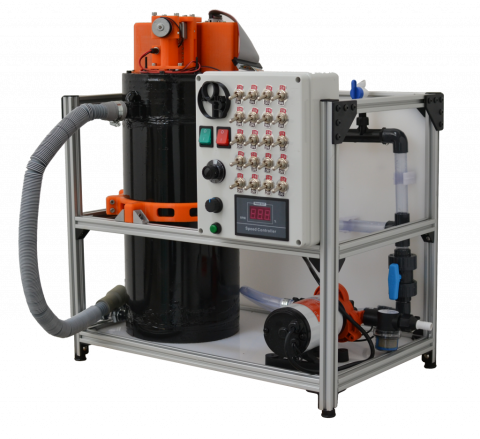
Pipe-flow Model
AquaB used its in-line, pipe-based NB generator at up to 100 l/min to perform irrigation, which gives NB levels of 108 per ml, and typically enhances some plant-growth stages by over a third:
This has also been used – very successfully – for CO2-NB generation for use in water-fogging for stomatal delivery to plants, as well as a water-carbonation feed line in the cultivation of algae in water.

Water “Nano-gasification” with Suspended Solids
This is a nanobubble generator designed for continuous-flow processing of suspended-solids water.
Taking in just ambient air, the oxidation/stripping of ammonia is spectacular in samples of activated-sludge water.
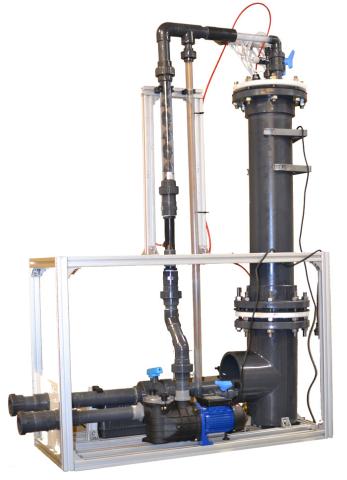
Water “Nano-gasification” in Cleaner Water
We can carry our nano-aeration or nano-gasification in a continuous-flow generator for water without appreciable suspended solids, with the option of an ‘oxygen-surge’ generator to boost DO even further. This model can do up to 200 l/min with 108 NBs per ml.
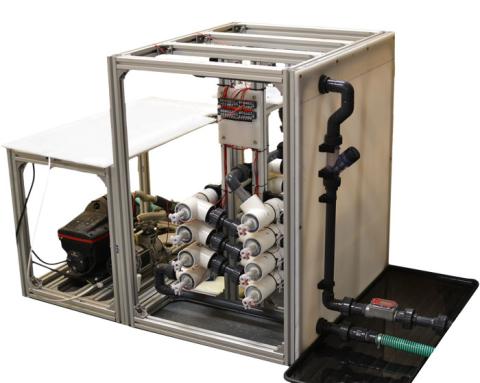
Submersible-Generator Design
AquaB used a smaller-scale immersed design as per below – which is “plug-and-play” with a low-power air pump to supply coarse air bubbles thereto for conversion into nano-bubbles. This is very effective where the water residence time is more than a few hours.
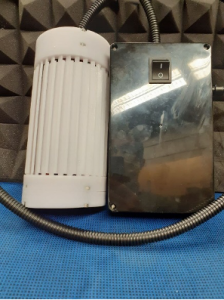
Test-Tube Unit
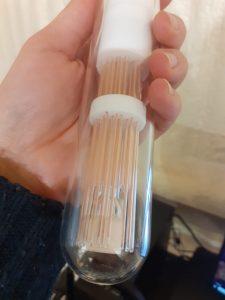
For those needing to ‘nano-gasify’ efficiently 20-50 ml in a test-tube, this test-tube unit below is exceedingly useful, operating at up to 109 NBs per ml. This means that analytical chemistry and research laboratories can use AquaB’s ultra-dense NBs as a catalyst for new discoveries and facilitate potential academic/research collaborations, should this be of potential mutual interest.